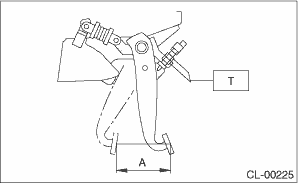
1. If the full stroke of the clutch pedal is not within the specified value, loosen the lock nuts of the clutch switch and adjust the full stroke of the clutch pedal with the clutch switch.
CAUTION:
When adjusting the full stroke of clutch pedal, do not turn the clutch switch.
NOTE:
If the lock nut cannot adjust the full stroke of clutch pedal to the specified value, adjust it by turning the master cylinder push rod.
Clutch pedal full stroke A:
130 — 135 mm (5.12 — 5.31 in) (gasoline non-turbo model)
135 — 140 mm (5.31 — 5.51 in) (gasoline turbo and diesel turbo model)
Tightening torque (Clutch switch lock nut):
T: 8 N·m (0.8 kgf-m, 5.9 ft-lb)
2. Loosen the push rod lock nuts.
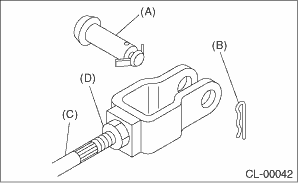
|
(A) |
Clevis pin |
|
(B) |
Snap pin |
|
(C) |
Push rod |
|
(D) |
Push rod lock nut |
3. Rotate the push rod to adjust.
(1) Make sure that the clutch pedal contacts the clutch switch side when the pedal is released.
(2) Make sure that the clutch pedal contacts the clutch pedal bracket stopper when the clutch pedal is at the maximum stroke position.
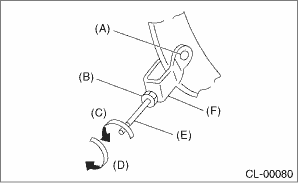
|
(A) |
Clevis hole |
|
(B) |
Push rod lock nut |
|
(C) |
In the shorter direction |
|
(D) |
In the longer direction |
|
(E) |
Push rod |
|
(F) |
Clevis |
4. Turn the push rod to shorten until a clearance is gained on the clutch switch side.
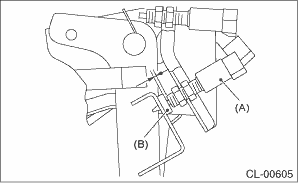
|
(A) |
Clutch switch |
|
(B) |
Stopper |
5. Turn the push rod to lengthen until clutch pedal contacts the clutch switch.
6. Turn further in the direction that will shorten the push rod (arrow direction shown in figure) by 270°.
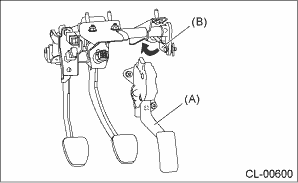
|
(A) |
Accelerator pedal |
|
(B) |
Clevis |
7. Check that the clevis pin moves smoothly by moving it in the left and right directions.
8. Tighten the push rod lock nut of the master cylinder.
Tightening torque (Push rod lock nut):
T: 10 N·m (1.0 kgf-m, 7.4 ft-lb)
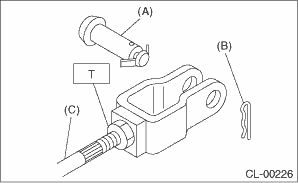
|
(A) |
Clevis pin |
|
(B) |
Snap pin |
|
(C) |
Push rod |
9. Depress and release the clutch pedal two or three times to ensure that the clutch pedal and release lever operate smoothly. If the clutch pedal and release lever do not operate smoothly, bleed air from the clutch hydraulic system. 
10. Measure the clutch pedal full stroke length again to ensure that it is within specifications. If it is not within specifications, repeat adjustment procedures again from the beginning.
Clutch pedal full stroke:
130 — 135 mm (5.12 — 5.31 in) (gasoline non-turbo model)
135 — 140 mm (5.31 — 5.51 in) (gasoline turbo and diesel turbo model)
11. Push the release lever until the operating cylinder push rod retracts. Make sure that the clutch fluid level in the reservoir tank increases. If the clutch fluid level increases, the hydraulic clutch is properly adjusted; If the fluid level does not increase or the push rod does not retract, replace the master cylinder with a new part.
NOTE:
The illustration shows a representing model. Perform the same procedures for the other models.
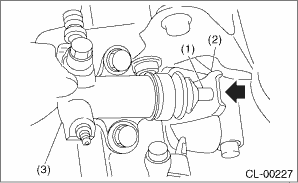
|
(1) |
Push rod |
|
(2) |
Release lever |
|
(3) |
Operating cylinder |
12. Push the release lever until the operating cylinder push rod retracts. Check that the clutch fluid level in the reservoir tank increases.
|
(1) |
Push rod |
|
(2) |
Release lever |
|
(3) |
Operating cylinder |
13. If the clutch fluid level increases, hydraulic clutch play is correct.
14. If the clutch fluid level does not increase or push rod does not retract, readjust the clutch pedal.
15. Check the fluid level using the scale on the outside of the reservoir tank. If the level is below “MIN”, fill fluid up to “MAX” level.
Recommended clutch fluid:
New FMVSS No. 116 DOT3 or DOT4 brake fluid
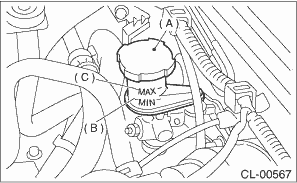
|
(A) |
Reservoir tank |
|
(B) |
MIN. level |
|
(C) |
MAX. level |
1. If the full stroke of the clutch pedal is not within the specified value, loosen the lock nuts of the clutch switch and adjust the full stroke of the clutch pedal with the clutch switch.
CAUTION:
When adjusting the full stroke of clutch pedal, do not turn the clutch switch.
NOTE:
If the clutch switch cannot adjust the full stroke of clutch pedal to the specified value, adjust it by turning the master cylinder push rod.
Clutch pedal full stroke A:
130 — 135 mm (5.12 — 5.31 in) (gasoline non-turbo model)
135 — 140 mm (5.31 — 5.51 in) (gasoline turbo and diesel turbo model)
Tightening torque (Clutch switch lock nut):
T: 8 N·m (0.8 kgf-m, 5.9 ft-lb)
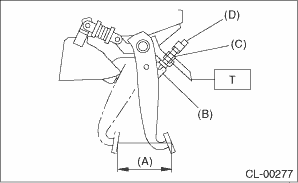
|
(A) |
Clutch stroke |
|
(B) |
Stopper |
|
(C) |
Lock nut |
|
(D) |
Clutch switch |
2. Turn the master cylinder push rod to move the clevis pin to the left, then to the right. The clevis pin should move without resistance even if it is rattling.
Tightening torque (Push rod lock nut):
T: 10 N·m (1.0 kgf-m, 7.4 ft-lb)
|
(A) |
Clevis pin |
|
(B) |
Snap pin |
|
(C) |
Push rod |
3. Depress and release the clutch pedal two or three times to ensure that the clutch pedal and release fork operate smoothly. If the clutch pedal and release fork do not operate smoothly, bleed air from the clutch hydraulic system.
4. Measure the clutch pedal full stroke length again to ensure that it is within specifications. If it is not within specifications, repeat adjustment procedures again from the beginning.
Clutch pedal full stroke:
130 — 135 mm (5.12 — 5.31 in) (gasoline non-turbo model)
135 — 140 mm (5.31 — 5.51 in) (gasoline turbo and diesel turbo model)
5. Move the clevis pin to left, then to right. The clevis pin should move without resistance even if it is rattling. If resistance is felt, repeat adjustment procedures again from the beginning.
6. Push the release lever until the operating cylinder push rod retracts. Make sure that the clutch fluid level in the reservoir tank increases. If the clutch fluid level increases, the hydraulic clutch is properly adjusted; If the fluid level does not increase or the push rod does not retract, replace the master cylinder with a new part.
NOTE:
The illustration shows a representing model. Perform the same procedures for the other models.
|
(1) |
Push rod |
|
(2) |
Release lever |
|
(3) |
Operating cylinder |
7. Check the fluid level using the scale on the outside of the reservoir tank. If the level is below “MIN”, fill fluid up to “MAX” level.
Recommended clutch fluid:
New FMVSS No. 116 DOT3 or DOT4 brake fluid
|
(A) |
Reservoir tank |
|
(B) |
MIN. level |
|
(C) |
MAX. level |