Repair or replace the differential gear in the following cases:
• When the hypoid drive gear and drive pinion shaft tooth surfaces are damaged, excessively worn, or seized.
• When the roller bearing on the drive pinion shaft has a worn or damaged roller path.
• When there is damage, wear or seizure of the differential bevel pinion, differential bevel gear, washer, pinion shaft or straight pin.
• When the differential case has worn or damaged sliding surfaces.
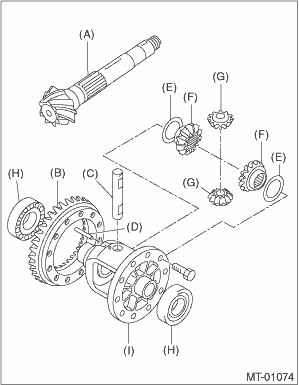
|
(A) |
Drive pinion shaft |
|
(B) |
Hypoid driven gear |
|
(C) |
Pinion shaft |
|
(D) |
Straight pin |
|
(E) |
Washer |
|
(F) |
Differential bevel gear |
|
(G) |
Differential bevel pinion |
|
(H) |
Roller bearing |
|
(I) |
Differential case |
Measure the backlash between differential bevel gear and differential bevel pinion. If backlash is not within specified value, install a suitable washer to adjust. 
NOTE:
Be sure the pinion gear teeth contacts adjacent gear teeth during measurement.
| ST1 498247001 | MAGNET BASE |
| ST2 498247100 | DIAL GAUGE |
Standard backlash
0.13 — 0.18 mm (0.0051 — 0.0071 in)
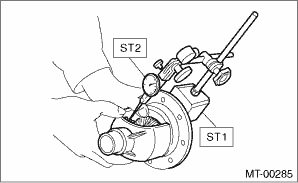
1. Set the ST1, ST2 and ST3. Insert the needle through transmission oil drain plug hole so that the needle comes in contact with the tooth surface on the right corner, and check the backlash.
| ST1 498247001 | MAGNET BASE |
| ST2 498247100 | DIAL GAUGE |
| ST3 498255400 | PLATE |
2. Install SUBARU genuine axle shafts to both sides, rotate in the inversion direction so that the gauge contacts the tooth surface, and read the dial gauge
| Part No. 38415AA100 | AXLE SHAFT |
Backlash:
0.13 — 0.18 mm (0.0051 — 0.0071 in)
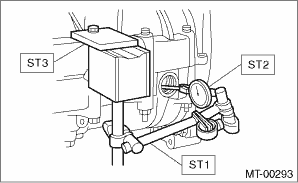
NOTE:
If the backlash is outside the specified range, adjust it by turning the side retainer in the right side case.
3. TOOTH CONTACT OF HYPOID GEAR
Check tooth contact of hypoid gear as follows. Apply a thin uniform coat of lead-free red dye on the surfaces of 3 or 4 hypoid gear teeth. Move the hypoid gear back and forth by turning the transmission main shaft until a definite contact pattern is developed on the hypoid gear, and judge whether face contact is correct. When the contact pattern is not correct, adjust.
• Tooth contact is correct.
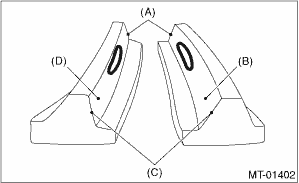
|
(A) |
Toe |
|
(B) |
Coast side |
|
(C) |
Heel |
|
(D) |
Drive side |