CONTROL SYSTEMS > AT Shift Lock Control System

INSPECTION

1. SHIFT LOCK OPERATION

MODEL WITHOUT PUSH BUTTON IGNITION SWITCH

STEPCHECKYESNO

1.CHECK COMMUNICATION OF SUBARU SELECT MONITOR.

1) Turn the ignition switch to ON.

2) Using the Subaru Select Monitor, check whether communication to all systems can be executed normally.

Is the system name displayed?

Perform the inspection following the diagnostic procedure in the LAN section.

2.CHECK SHIFT LOCK.

1) Turn the ignition switch to ON.

2) Shift the select lever to “P” range.

While brake pedal is not depressed, is it possible to move the select lever from the “P” range to other ranges?

Perform the inspection of “SELECT LEVER CANNOT BE LOCKED OR RELEASED”.

3.CHECK SHIFT LOCK.

While brake pedal is depressed, is it possible to move the select lever from the “P” range to other ranges?

Perform the inspection of “SELECT LEVER CANNOT BE LOCKED OR RELEASED”.

4.CHECK SHIFT LOCK.

Shift the select lever to “N” range.

Is it possible to move the select lever from the “N” range to the “P” range?

Perform the inspection of “SELECT LEVER CANNOT BE LOCKED OR RELEASED”.

5.CHECK SHIFT LOCK.

1) Shift the select lever to “N” range.

2) Turn the ignition switch to OFF.

While brake pedal is depressed, is it possible to move the select lever from the “N” range to the “P” range?

Perform the inspection of “SELECT LEVER CANNOT BE LOCKED OR RELEASED”.

6.CHECK KEY INTERLOCK.

1) Turn the ignition switch to OFF.

2) Shift the select lever to other than “P” range.

Can the ignition key be removed?

Perform the inspection of “KEY INTERLOCK CANNOT BE LOCKED OR RELEASED”.

7.CHECK KEY INTERLOCK.

Shift the select lever to “P” range.

Can the ignition key be removed?

AT shift lock system is normal.

Perform the inspection of “KEY INTERLOCK CANNOT BE LOCKED OR RELEASED”.

MODEL WITH PUSH BUTTON IGNITION SWITCH

STEPCHECKYESNO

1.CHECK COMMUNICATION OF SUBARU SELECT MONITOR.

1) Turn the ignition switch to ON.

2) Using the Subaru Select Monitor, check whether communication to all systems can be executed normally.

Is the system name displayed?

Perform the inspection following the diagnostic procedure in the LAN section.

2.CHECK SHIFT LOCK.

1) Turn the ignition switch to ON.

2) Shift the select lever to “P” range.

While brake pedal is not depressed, is it possible to move the select lever from the “P” range to other ranges?

Perform the inspection of “SELECT LEVER CANNOT BE LOCKED OR RELEASED”.

3.CHECK SHIFT LOCK.

While brake pedal is depressed, is it possible to move the select lever from the “P” range to other ranges?

Perform the inspection of “SELECT LEVER CANNOT BE LOCKED OR RELEASED”.

4.CHECK SHIFT LOCK.

Shift the select lever to “N” range.

Is it possible to move the select lever from the “N” range to the “P” range?

Perform the inspection of “SELECT LEVER CANNOT BE LOCKED OR RELEASED”.

5.CHECK SHIFT LOCK.

1) Shift the select lever to “N” range.

2) Turn the ignition switch to OFF.

While brake pedal is depressed, is it possible to move the select lever from the “N” range to the “P” range?

AT shift lock system is normal.

Perform the inspection of “SELECT LEVER CANNOT BE LOCKED OR RELEASED”.

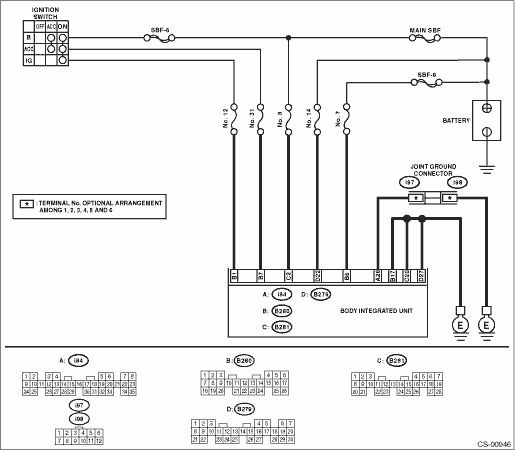
2. BODY INTEGRATED UNIT POWER SUPPLY AND GROUND CIRCUIT

STEPCHECKYESNO

1.CHECK DTC OF BODY INTEGRATED UNIT.

Check DTC of body integrated unit.

Is the DTC of power line displayed on body integrated unit?

Repair or replace it according to the DTC.

2.CHECK HARNESS CONNECTOR BETWEEN BODY INTEGRATED UNIT AND CHASSIS GROUND.

1) Turn the ignition switch to ON.

2) Measure the voltage between body integrated unit and chassis ground.

Connector & terminal

(B280) No. 1 (+) — Chassis ground (−):

(B280) No. 6 (+) — Chassis ground (−):

(B280) No. 7 (+) — Chassis ground (−):

(B279) No. 22 (+) — Chassis ground (−):

Is the voltage 9 — 16 V?

Check the harness for open circuit between body integrated unit and battery, and check the fuses.

3.CHECK HARNESS CONNECTOR BETWEEN BODY INTEGRATED UNIT AND CHASSIS GROUND.

1) Turn the ignition switch to OFF.

2) Measure the harness resistance between the body integrated unit and chassis ground.

Connector & terminal

(i84) No. 28 — Chassis ground:

(B279) No. 27 — Chassis ground:

(B280) No. 17 — Chassis ground:

(B281) No. 20 — Chassis ground:

Is the resistance less than 1 Ω?

Repair the open circuit of harness between the body integrated unit and chassis ground.

4.CHECK POOR CONTACT.

Is there poor contact of connector?

Repair the poor contact.

End.

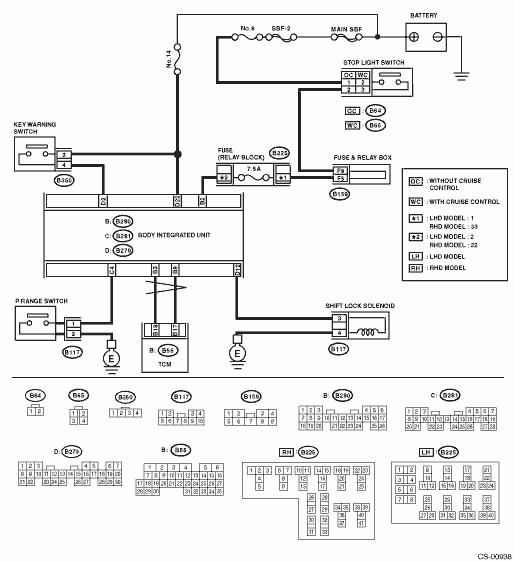
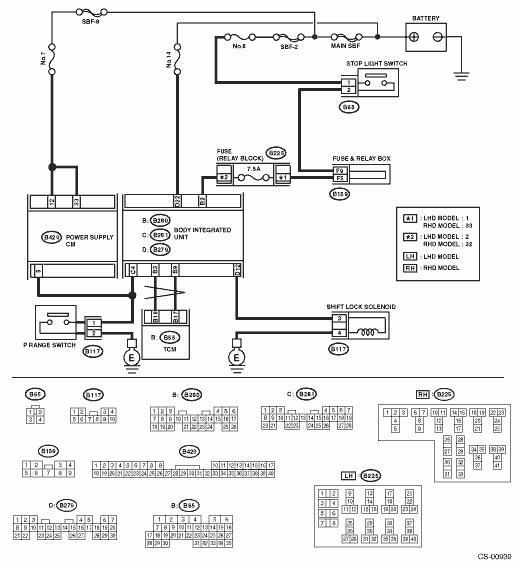
3. SELECT LEVER CANNOT BE LOCKED OR RELEASED

MODEL WITHOUT PUSH BUTTON IGNITION SWITCH
MODEL WITH PUSH BUTTON IGNITION SWITCH
STEPCHECKYESNO

1.CHECK BODY INTEGRATED UNIT POWER SUPPLY AND GROUND CIRCUIT.

Is there an abnormal condition?

Follow the procedures to perform inspection and repair.

2.CHECK CURRENT DATA.

1) Connect the Subaru Select Monitor.

2) Shift the select lever to “P” range.

3) Turn the ignition switch to ON.

4) Display the current data display and display «P SW».

Is the display “ON” in the P range and “OFF” in ranges other than P?

3.CHECK CURRENT DATA.

Display the current data display and display «Stop Light Switch».

Is “ON” displayed when the brake pedal is depressed and “OFF” displayed when the brake pedal is released?

4.CHECK BODY INTEGRATED UNIT DTC.

Check the DTC of the body integrated unit when the brake pedal is pressed and when it is released.

(Hold each condition for 5 seconds or more.)

Is there a DTC of a current malfunction?

Follow the DTC to perform inspection and repair.

5.CHECK CURRENT DATA.

Select the current data display and display «Shift Lock Solenoid».

Is “ON” displayed when the brake pedal is depressed and “OFF” displayed when the brake pedal is released?

Replace the body integrated unit.

6.CHECK CURRENT DATA.

Select the current data display and display «Shift Position».

Is the display “7” in the P range and other than “7” in ranges other than P?

Check the following items.

Inhibitor switch

Harness between inhibitor switch and TCM

TCM input signal

TCM CAN communication

Body integrated unit CAN receive

7.CHECK CURRENT DATA.

1) Select the current data display and display «Front Wheel Speed».

2) Start the engine.

3) Raise vehicle speed gradually up to approximately 20 km/h.

Is a figure equivalent to the speedometer being indicated?

Check the following items.

Wheel speed sensor

VDC/ABS CAN communication

Body integrated unit CAN receive

Replace the wheel speed sensor, VDC/ABS, or body integrated unit, or both.

8.CHECK HARNESS BETWEEN BODY INTEGRATED UNIT AND “P” RANGE SWITCH.

1) Disconnect the connector from body integrated unit.

2) Disconnect the connector of “P” range switch.

3) Check for open circuit of harness, short circuit to battery or short circuit to ground between the body integrated unit and “P” range switch.

Connector & terminal

(B281) No. 4 — (B117) No. 1:

Is the harness normal?

Repair or replace the harness between the body integrated unit and the “P” range switch.

9.CHECK HARNESS BETWEEN “P” RANGE SWITCH AND CHASSIS GROUND.

Measure the resistance of harness between “P” range switch and chassis ground.

Connector & terminal

(B117) No. 2 — Chassis ground:

Is it less than 10 Ω?

Repair the harness between the “P” range switch and chassis ground.

10.CHECK “P” RANGE SWITCH.

Measure the resistance between “P” range switch connector terminals.

Terminals

No. 2 — No. 1:

Is it less than 10 Ω in the “P” range, and 1 MΩ or more in ranges other than “P”?

Replace the body integrated unit.

Replace the “P” range switch.

11.CHECK STOP LIGHT SWITCH INPUT SIGNAL.

1) Disconnect the connector from body integrated unit.

2) Measure the voltage between the body integrated unit connector terminal and chassis ground.

Connector & terminal

(B280) No. 2 (+) — Chassis ground (−):

Is the voltage 9 V or more when the brake pedal is depressed, and less than approximately 1.5 V when not pressed?

Replace the body integrated unit.

Check the stop light system.

12.CHECK SHIFT LOCK SOLENOID OPERATION.

Connect the battery to the shift lock solenoid unit connector terminal, and operate the solenoid.

Terminals

No. 3 (+) — No. 4 (−):

Does the shift lock solenoid operate normally?

Check the lock mechanism of the select lever body.

Replace the shift lock solenoid.

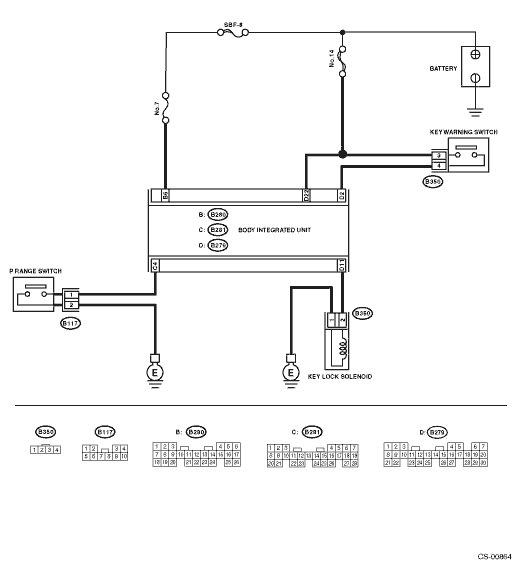
4. KEY INTERLOCK CANNOT BE LOCKED OR RELEASED

NOTE:

Check of this item only applies to models without a push button ignition switch.
STEPCHECKYESNO

1.CHECK BODY INTEGRATED UNIT POWER SUPPLY AND GROUND CIRCUIT.

Is there an abnormal condition?

Follow the procedures to inspect and repair.

2.CHECK CURRENT DATA.

1) Connect the Subaru Select Monitor.

2) Shift the select lever to “P” range.

3) Turn the ignition switch to ON.

4) Display the current data display and display «P SW».

Is the display “ON” in the P range and “OFF” in ranges other than P?

3.CHECK CURRENT DATA.

1) Select the current data display and display the «Key-lock warning SW».

2) Turn the ignition switch to OFF.

Does the display change from “ON” to “OFF” when the key is inserted and removed?

4.CHECK CURRENT DATA.

1) Turn the ignition switch to ON.

2) Select the current data display and display «Key locking output».

Is the display “ON” in the P range and “OFF” in ranges other than P?

5.CHECK DTC OF BODY INTEGRATED UNIT.

1) Shift the select lever to other than “P” range.

2) Check DTC of body integrated unit.

Is B1105 (key interlock circuit malfunction) a current malfunction?

Follow the DTC to perform inspection and repair.

6.CHECK HARNESS BETWEEN BODY INTEGRATED UNIT AND “P” RANGE SWITCH.

1) Disconnect the connector from body integrated unit.

2) Disconnect the connector of “P” range switch.

3) Check for open circuit of harness, short circuit to battery or short circuit to ground between the body integrated unit and “P” range switch.

Connector & terminal

(B281) No. 4 — (B117) No. 1:

Is the harness normal?

Repair or replace the harness between the body integrated unit and the “P” range switch.

7.CHECK HARNESS BETWEEN “P” RANGE SWITCH AND CHASSIS GROUND.

Measure the resistance of harness between “P” range switch and chassis ground.

Connector & terminal

(B117) No. 2 — Chassis ground:

Is it less than 10 Ω?

Repair the harness between the “P” range switch and chassis ground.

8.CHECK “P” RANGE SWITCH.

Measure the resistance between “P” range switch connector terminals.

Terminals

No. 2 — No. 1:

Is it less than 10 Ω in the “P” range, and 1 MΩ or more in ranges other than “P”?

Replace the body integrated unit.

Replace the “P” range switch.

9.CHECK HARNESS BETWEEN BATTERY AND KEY WARNING SWITCH AND BODY INTEGRATED UNIT.

1) Disconnect the connector from body integrated unit.

2) Measure the voltage between body integrated unit and chassis ground.

Connector & terminal

(B279) No. 2 — Chassis ground:

Is the display 9 V or more when the key is inserted, and less than 1.5 V with the key removed?

Replace the body integrated unit.

Check the following items.

Key warning switch

Harness/fuse

Ignition circuit

10.CHECK HARNESS BETWEEN BODY INTEGRATED UNIT AND KEY LOCK SOLENOID.

1) Disconnect the connector from body integrated unit.

2) Disconnect the connector of key lock solenoid.

3) Check for open circuit of harness, short circuit to battery or short circuit to ground between the body integrated unit and key lock solenoid.

Connector & terminal

(B279) No. 11 — (B350) No. 2:

Is the harness normal?

Repair or replace the harness between the body integrated unit and the key lock solenoid.

11.CHECK HARNESS BETWEEN KEY LOCK SOLENOID AND CHASSIS GROUND.

Measure the resistance of harness between key lock solenoid and chassis ground.

Connector & terminal

(B350) No. 1 — Chassis ground:

Is it less than 10 Ω?

Repair or replace the harness between the key lock solenoid and chassis ground.

12.CHECK KEY LOCK SOLENOID OPERATION.

Connect the battery to the key lock solenoid connector terminal, and operate the solenoid.

Does the key lock solenoid operate normally?

Replace the key lock solenoid.

13.CHECK OUTPUT OF BODY INTEGRATED UNIT.

1) Connect all connectors.

2) Insert the key.

3) Measure the voltage between body integrated unit and chassis ground.

Connector & terminal

(B279) No. 11 — Chassis ground:

Is it 5 V or more in ranges other than “P”, and less than 1.5 V in the “P” range?

Check the lock mechanism of the steering lock body.

Replace the body integrated unit.