1. Visually inspect to make sure that there are no cracks, scratches or other damage.
2. Use liquid penetrant tester on the important sections to check for fissures.
3. Check that there are no marks of gas leaking or water leaking on gasket attachment surface.
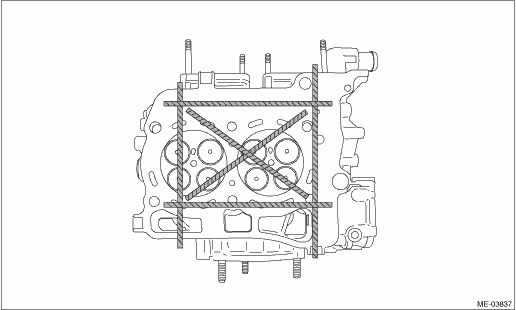
4. Check for warpage of mating surfaces of the cylinder block and cylinder head using a straight edge and thickness gauge. If the warpage exceeds the limit, replace the cylinder head.
Warping limit:
0.035 mm (0.0014 in)
Standard height of cylinder head:
110.7 mm (4.3583 in)
NOTE:
If the cylinder head bolt tightening torques and angle tightening is uneven, warpage of the cylinder head may occur. During installation work, make sure that tightening torque and angle tightening work is performed precisely so that it is tightened evenly.
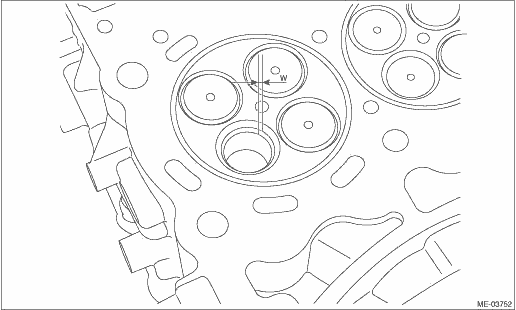
Inspect the intake and exhaust valve seats, and correct the contact surfaces with a valve seat cutter if they are defective or when valve guides are replaced.
Valve seat width W:
Standard
Intake
1.4 — 2.1 mm (0.0551 — 0.0827 in)
Exhaust
1.4 — 2.1 mm (0.0551 — 0.0827 in)
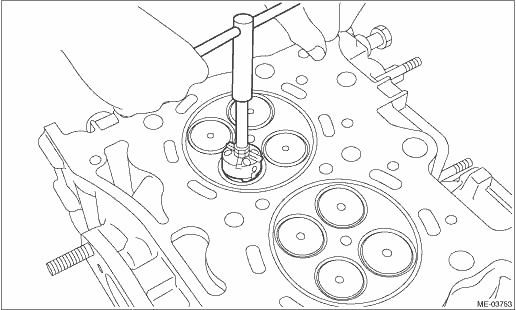
1. Check the clearance between valve guide and stem.
Measure the outer diameter of valve stem with a micrometer and the inner diameter of valve guide with a caliper gauge.
Valve guide inner diameter:
6.000 — 6.012 mm (0.2362 — 0.2367 in)
Valve stem outer diameters:
Intake:
5.965 — 5.980 mm (0.2348 — 0.2354 in)
Exhaust:
5.955 — 5.970 mm (0.2344 — 0.2350 in)
Clearance between the valve guide and valve stem:
Standard
Intake
0.020 — 0.047 mm (0.0008 — 0.0020 in)
Exhaust
0.030 — 0.057 mm (0.0012 — 0.0022 in)
2. If the clearance between valve guide and stem exceeds the standard, replace the valve guide or valve itself whichever shows greater amount of wear or damaged and etc.
1. Visually inspect the valve flange and stem, and if damage, wear or deformation is occurring, replace with new valves.
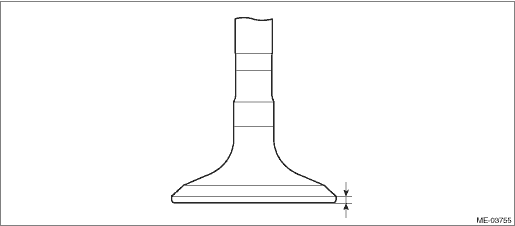
2. Measure the head edge thickness of the intake and exhaust valves, and if they are out of standard, replace with a new valve.
Head edge thickness:
1.0 mm (0.0394 in)
3. Put a small amount of grinding compound on the seat surface, and lap the valve and seat surface.
Replace with a new stem seal after lapping.
NOTE:
Judge intake and exhaust valves by their total length.
Valve overall length:
Intake
81.6 mm (3.2126 in)
Exhaust
80.4 mm (3.1653 in)
1. Visually check that there is no damage on the valve springs, and inspect the free length and tension.
If they are not within the standard, replace with new valve springs.
Free length:
39.37 mm (1.5500 in)
Tension/spring height:
Set:
174 — 200 N (17.7 — 20.4 kgf, 39.1 — 45.0 lb)/28.92 mm (1.1386 in)
Lift:
330 — 370 N (33.6 — 37.7 kgf, 74.2 — 83.2 lb)/19.92 mm (0.7843 in)
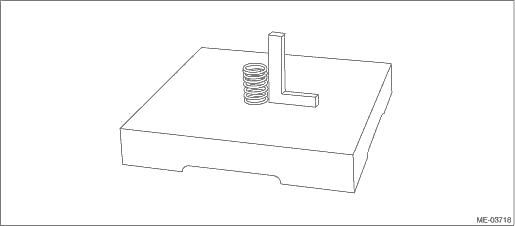
2. To measure the squareness of the valve spring, stand the valve spring on a surface plate and measure its deflection at the top of valve spring using a right angle gauge.
Squareness:
2.5°, 1.6 mm (0.0629 in) or less
1. In the following cases, replace with new stem seals.
For replacement procedures, refer to “3. Valve Guide”. 
• When the lip is damaged
• When the spring is out of the specified position
• When readjusting the surfaces of valve and valve seat
• When replacing the valve guide