Check all disassembled parts for wear, damage or other problems. Repair or replace the defective parts as necessary.
|
Part |
Inspection |
Corrective action |
|
Pipe |
• O-ring fitting surface damage • Nut damage • Pipe damage |
Replace with a new part. |
|
Clamp |
• Loose clamps |
Replace with a new part. |
|
Hose |
• Flare surface damage • Flare nut damage • Outer surface cracks • Outer surface wear • Clip damage • End coupling or adapter deformation |
Replace with a new part. |
CAUTION:
Although the surface layer materials of rubber hoses have excellent weathering resistance, heat resistance and resistance for low temperature brittleness, they will be damaged chemically by brake fluid, battery electrolyte, engine oil and automatic transmission fluid and their service lives will be very shortened. Wipe off hoses immediately if any of these come into contact with the hoses.
Since resistances for heat and low temperature brittleness gradually declines according to long periods of exposure to hot or cold conditions, and their service lives are shortening accordingly. It is necessary to perform careful inspection frequently when the vehicle is used in hot weather areas, cold weather areas and in frequent driving conditions where a lot of steering work is required.
Particularly when there is continuous operation of the relief valve for 5 seconds or more, the life of the hoses, oil pump, and fluid will be shortened due to overheating.
|
Malfunction |
Possible cause |
Corrective action |
|
Pressure hose burst |
Excessive holding time of relief status |
Instruct customers. |
|
Malfunction of the relief valve |
Replace the oil pump. | |
|
Poor cold characteristic of fluid |
Replace fluid. | |
|
Disconnection of the return hose |
Improper connection |
Correct |
|
Loosening of the clip |
Retighten | |
|
Poor cold characteristic of fluid |
Replace fluid. | |
|
Fluid slightly leaking out of hose |
Wrong piping layout and tension |
Replace the hose. |
|
Excessive play of engine due to deterioration of engine mounting rubber |
Replace the parts if defective. | |
|
Improper stop position of pitching stopper |
Replace the parts if defective. | |
|
Crack on hose |
Excessive holding time of relief status |
• Replace • Instruct customers. |
|
Excessive tightening torque for return hose clip |
Replace | |
|
Power steering fluid, brake fluid, engine oil, or electrolyte coming into contact with the hose surface |
• Replace • Be careful during service work. | |
|
Too many uses in extremely cold weather |
• Replace • Instruct customers. |
NOTE:
There are conditions in which a fluid leak is diagnosed, but is not actually leaking. This is because the fluid spilt during the last maintenance was not completely wiped off. Be sure to wipe off spilt fluid thoroughly after maintenance.
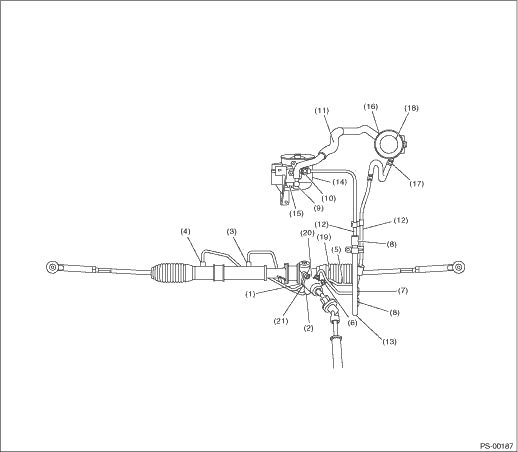
|
Fluid leaking area |
Possible cause |
Corrective action |
|
Leakage from the connections of pipes and hoses, numbered (1) through (10) in the figure |
Insufficient tightening of flare nuts, dirt accumulation, damage to flare or flare nut or eye bolt |
Loosen and retighten. Replace if ineffective. |
|
Improper installation of hose or clamp |
Retighten or replace the clamp. | |
|
Damaged O-ring or gasket |
Replace the O-ring, gasket pipe or hose with new parts, and if there is still no improvement, replace the gearbox. | |
|
Leakage from hose (11), (12) and (13) in the figure |
Crack or damage in hose |
Replace with a new part. |
|
Crack or damage in hose hardware |
Replace with a new part. | |
|
Leakage from surrounding of cast iron portion of oil pump, (14) and (15) in the figure |
Damaged O-ring |
Replace the oil pump. |
|
Damaged gasket |
Replace the oil pump. | |
|
Leakage from reservoir (16) and (17) in the figure |
Crack in the reservoir tank |
Replace the reservoir tank. |
|
Leakage from filler neck of (18) |
Damaged cap gasket |
Replace the cap. |
|
Crack in root of filler neck |
Replace the reservoir tank. | |
|
Fluid level too high |
Adjust the fluid level. | |
|
Leakage from power cylinder of gearbox area (19) in the figure |
Damaged oil seal |
Replace the oil seal. |
|
Leakage from (20), (21) in the figure and control valve of gearbox |
Damaged gasket or oil seal |
Replace the problem parts. |
|
Damage in control valve |
Replace the control valve. |